

Neurotherapy
Restore balance and support your brain with Neurotherapy.
Your brain is a network of signals constantly communicating to control your thoughts, emotions, and actions. When these signals get disrupted, it can leave you feeling scattered, stressed, or unfocused. Neurotherapy uses safe, non-invasive techniques to retrain your brain’s activity, improving communication and restoring balance. Over time, your brain strengthens these pathways so you can process information more efficiently and feel more centered.
We start with a detailed assessment of your brain’s electrical activity, creating a “blueprint” that shows how your brain is functioning in real time. This insight allows us to create a customized plan tailored to your unique needs. From there, with each training session, your brain becomes stronger, more coordinated, and better able to process the information coming in from your world.
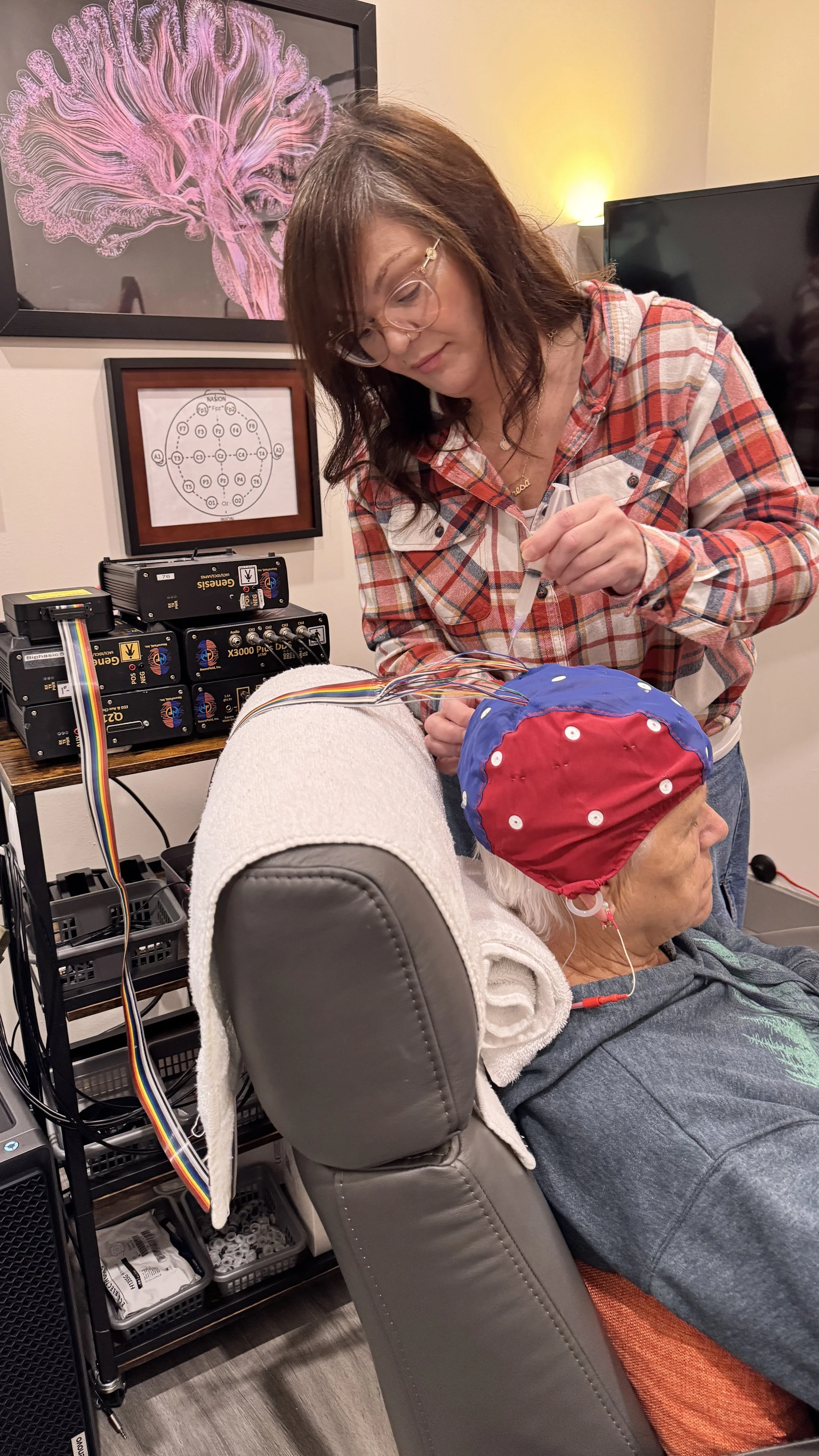
Neurotherapy improves brain function by:
Increasing blood flow
Decreasing inflammation
Growing new blood vessels and capillaries
Stimulating mitochondria and increasing energy
Neurogenesis – creating new neuronal connections
We use a variety of neuromodulation techniques, including:
Pulsed Electromagnetic Frequency Stimulation (pEMF)
Transcranial Alternating Current Stimulation (tACS), Transcranial Direct Current Stimulation (tDCS), or Transcranial Random Noise Stimulation (tRNS).
Photobiomodulation (PBM), also known as infrared light or light therapy
Vagus nerve stimulation (VNS)
Backed by Research, Neurotherapy can help with:
Mood Disorders: Anxiety and Depression
Focus issues and ADHD
Trauma and PTSD
Concussion / Traumatic Brain Injury (TBI)
Sleep issues
Peak Performance and Cognitive enhancement
You can learn more about Neurotherapy in this short video.
Frequently Asked Questions:
-
First, you’ll have a complimentary consultation with Dr. Ginette to discuss your goals and answer any questions. If this type of care is a good fit, your next step is an in-person assessment of your brain function, which includes a QEEG and an ERP test. This visit takes about 1.5 hours.
A QEEG (Quantitative Electroencephalogram) is a safe, non-invasive tool that measures your brain’s electrical activity and identifies areas that may be out of balance. During the session, a cap is placed on your head and your brain’s activity is recorded for 8–10 minutes, once with your eyes open and once with your eyes closed.
The ERP (Event Related Potential) test is a “computer test” for your brain, showing how your brain responds to specific events and stimuli. Together, these tests create a baseline of how your brain is functioning, which Dr. Ginette uses to design a personalized neurotherapy plan just for you.
-
Neurotherapy is like learning to ride a bike with training wheels. Neuromodulation acts as the training wheels, guiding your brain by introducing specific frequencies. Over time, your brain learns to produce these frequencies on its own, improving communication between different areas. This process encourages your brain to create new neural pathways, a natural ability called neuroplasticity, helping it restore balance, improve function, and respond more efficiently to daily challenges.
-
As with most forms of treatment, neurotherapy results will vary with each person. However, most will require 20-30 neurotherapy sessions depending on the patient’s condition and goals. Regular QEEG (brain maps) will be done to ensure we are getting results and are on the right track.
-
Just like working out, infrequent training will not produce lasting results. Therefore, most sessions will be done between 3-5 times per week. A minimum commitment is 3 sessions/week. Doing sessions once a week will not produce the results we are looking for. As care progresses and the brain is behaving in the correct manner, session may be reduced. Just like learning to ride a bike, once you know how to do it, you don’t need the training wheels!
Most sessions are 45-60 minutes. Patients relax in a comfy chair, read a book, meditate, listen to music or even take a nap!
-
Safety is at the heart of everything we do with neurotherapy. We want every patient to feel confident that these treatments are both gentle and effective. Our approach uses three primary, research-backed methods: photobiomodulation (light therapy), pulsed electromagnetic field (PEMF), and low-intensity transcranial stimulation. Each method interacts with the nervous system in a unique way, but the common thread is precision.
We carefully control the intensity, frequency, and timing of each session to ensure it stays within safe limits, guided by science and established protocols. Our goal is to help your brain retrain, rebalance, and function better, without risk, discomfort, or guesswork.
-
Yes! The changes created in the brain are long-lasting. Some patients return occasionally for “brain tune-ups” to maintain or enhance their results.
Success rates are typically 75–80%, though results vary by individual. That’s why we begin with a thorough assessment and intake to determine if neurotherapy is right for you. Progress is monitored at every session, and follow-up QEEGs are done at regular intervals to track changes and fine-tune your treatment plan.
-
Many clients notice positive changes after 10–15 neurotherapy sessions, though some feel improvements in mood, focus, or sleep even after the first session. Consistent treatment is important for creating lasting changes in the brain. After about 10–15 sessions, we take a follow-up QEEG to track progress and adjust your protocol as needed to help you reach your goals.
-
Short answer: No, a specific license isn’t required to practice neurotherapy.
For your safety, it’s best to work with a credentialed healthcare professional. Dr. Ginette is board certified in Neurofeedback through the Biofeedback Certification International Alliance (BCIA). You can learn more at www.bcia.org.
-
Neurotherapy and brain training have been studied for decades, with research and applications evolving steadily over time. Recent technological advances have made it more accessible, effective, and easy to use. Faster computers, improved sensors, and advanced software now allow us to measure and train brain activity accurately and efficiently.
If you have a brain-based struggle, you may need a brain-based solution. Neurotherapy is a holistic, evidence-based approach that uses gentle, non-invasive technology to enhance and optimize brain function.
-
Yes. Patients with recent head injuries (within the past 6 weeks), including any form of head trauma, concussion, or stroke, should consult a neurologist before starting neurotherapy. These injuries can affect blood vessels, and your brain needs time to heal before care begins. We can discuss your specific case during the consultation to determine the best next steps and whether an initial assessment or delayed start is most appropriate.
-
There’s a big difference! ECT is a medical procedure performed in a hospital under general anesthesia, using strong electrical currents to intentionally induce a seizure. Neurotherapy, on the other hand, is gentle and non-invasive. The amount of energy we use is incredibly small—less than 0.000002% of what’s used in ECT.
A simple way to think about it: ECT is like using a sledgehammer, while neurotherapy is more like a precise carving tool. It safely retrains and balances your brain without the risks or intensity of ECT.
-
We understand that cost and time are important considerations. Neurotherapy is an investment in lasting brain health.
To get started, your initial brain assessment includes two appointments: your comprehensive brain QEEG, health history, and testing session, followed by an in person Report of Findings where we review your results, explain what they mean, and discuss your personalized recommendations. The fee also includes the professional time required to thoroughly analyze and interpret your results.
From there, the total cost of care can vary depending on factors such as your concerns and treatment goals. Most care plans are completed over approximately 4-6months, allowing enough time to create meaningful and lasting changes in brain function.
All services provided by Dr. Ginette fall under chiropractic care. As coverage can vary, we recommend checking with your provider for the details of your individual plan.
Contact us to book your complimentary consultation with Dr. Ginette to discuss your needs and learn more.
Hear Their Experience
What More People Are Saying…